

Clóvis Graciano (1907-1988), the son of Italian immigrants, was an outstanding artist of the second generation of modernism in São Paulo. Following a two-year stay in Europe, during the latter phase of his career, the esteemed painter focused primarily on creating murals, including some on tiles.
The murals on Rubem Berta Avenue, commissioned by the council to celebrate the city’s anniversary, depict key moments in São Paulo’s history. These include the Jesuits’ journey up the Serra do Mar to reach the São Paulo plateau, the pioneering settlers who explored the Brazilian interior, the era of coffee production, the growth of industry, and, looking ahead to the future, a representation of the city with its tall buildings.
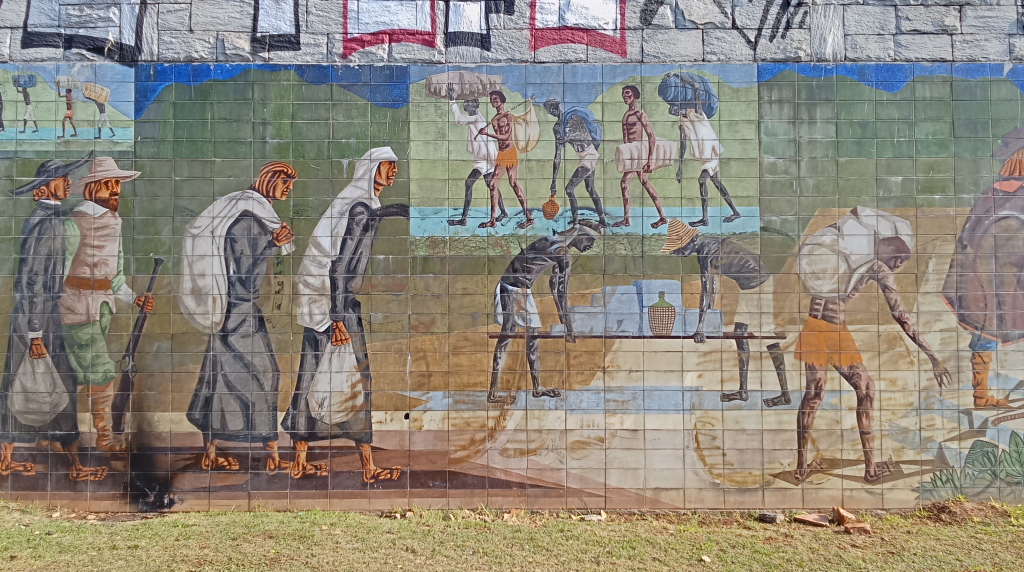
Graciano’s proposal for public art, reminiscent of the Mexican muralist movement, may lack the revolutionary fervor championed by David Siqueiros as the “antithesis to the painting of small pictures, a bourgeois, restricted, individualistic artistic modality, without repercussion on the masses.” However, the Brazilian believed it still possessed significant communicative power, as the tile panels would be visible to all travelers passing by the avenue connecting to Congonhas airport, which unveiled its international wing in 1959.
The mural is the most democratic form of painting. If desired, the government could commission murals to be painted in public spaces, such as train stations, sports facilities, and more. This is a way to make art accessible to all, immortalize historical moments, and ensure that everyone has the opportunity to appreciate them. While canvases may belong to a select few, murals belong to anyone who wishes to view them. (“São Paulo will display murals by Graciano at its entrance”, Folha de S. Paulo, January 15, 1969)
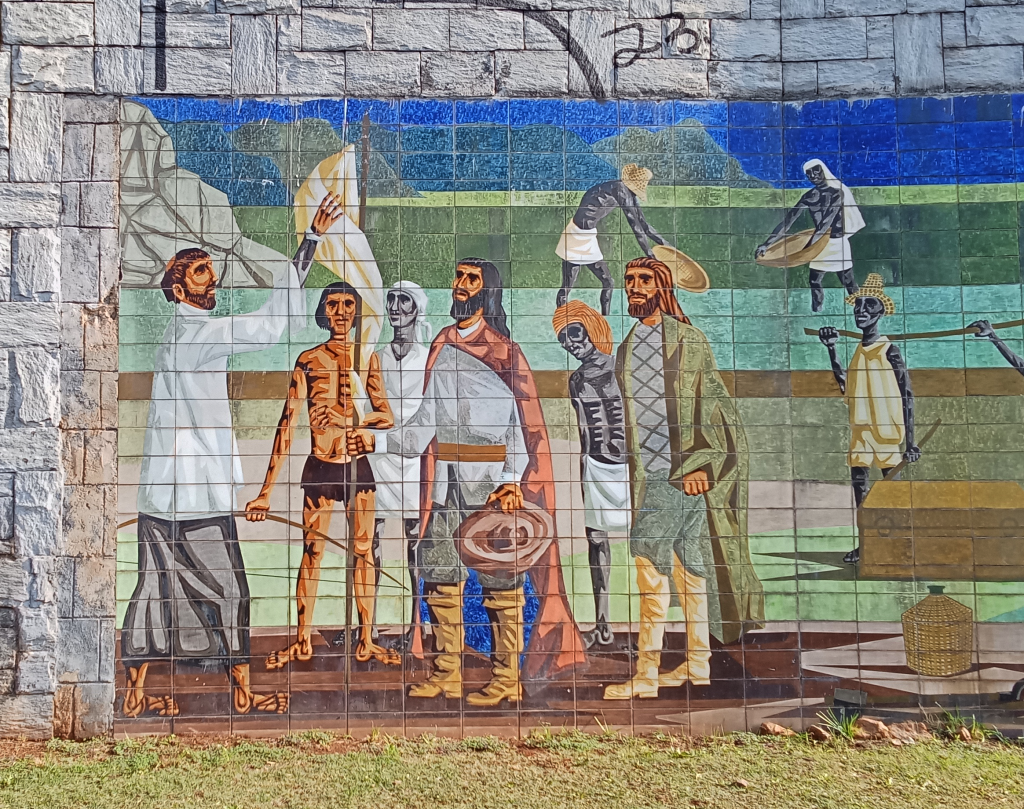
In a brilliant essay, at the beginning of the revelation of the São Paulo school (Escola Paulista), writer and critic Mário de Andrade described the Santa Helena Palace group as consisting of immigrants and their descendants who gradually evolved from anonymous decorators to respected painter-artists. Their sociological background accounted for their concern for traditional artistic genres such as portraiture, landscape, and still life, which ultimately revealed their aspiration for a higher social standing.
With this same sociological preference, Graciano emphasized the historical significance of economic cycles and depicted the heroic struggles of Indigenous peoples, black slaves, and workers. Assuming Marxist ideas, he underscored the importance of labor in the development of Brazilian society and sought to use art to give recognition to the anonymous efforts of the past. He portrayed the visible struggle and suffering of workers through their marked faces and tense muscles, achieving better artistic representation in his paintings compared to tile panels.

It is noteworthy that, while acknowledging the past, the artist’s eye shifts toward the future, condemning the inhumane architecture of the city’s imposing straight-lined buildings.
In a situation of commitment to the historical pride of São Paulo’s identity, which the municipal leaders claim to affirm, the omission of criticism of the social injustices of the present is compensated for by complaining about a desire for humanity that does not seem to be taken into account for the future of the inhabitants of São Paulo:
The city of the future, for me, will be an anonymous, impersonal city. No one will live in it. There will be a city where you can work and one where you can live. (“The art in the middle of the street”, Folha da Tarde, 1969)

For this “humanist” reason, the painter did not follow the path of geometric abstractionism that animated investigations into contemporary artistic creation. Either, the association with the history of the Portuguese tiles was primarily conceptual, lacking the backing of a technical heritage. This was coupled with the introduction of an entirely new range of ceramic hues, enabled by chemical and technological advancements. It was a firm belief of Clóvis Graciano to align himself with the spirit of his era, a pivotal quality in establishing himself as a contemporary artist.
BIBLIOGRAFIA ESSENCIAL
ANDRADE, Mário de. Ensaio sobre Clóvis Graciano. São Paulo, 1944.
FREITAS, Aline Hübner. Clóvis Graciano: Estratégias de amizade e as inter-relações entre os muralistas mexicanos e os modernistas brasileiros. Tese de doutoramento, Universidade Estadual de Campinas, 2023.
SANTOS, Wilson Vieira dos Santos (editor). O trabalho na arte brasileira. Modernismo. Organização Internacional do Trabalho, 1994.

 Portuguese Tiles